
By Mitch Wilson, Assistant Principal, Constance Lane Elementary School
I was digging through the PE closet looking for soccer shorts. Several of our fifth-grade boys had arrived for their first game in jeans and sweatpants, and I was trying to get them ready before they took the field. Then my radio crackled. “Hurder to Wilson, Njia just scored the first goal!” I stopped.
For this story, I’ll call him Njia, the Swahili word for “way” or “path.” A few weeks earlier, Njia had been moping through the hallway toward his bus line on the afternoon of soccer tryouts. He did not think he was staying.
For many students, trying out for a school team means staying after school for an hour or two. For many of our Swahili-speaking students, there is another question that has to be answered first: How am I going to get home?
I saw him heading toward the bus and called out. “Njia! You’re coming to soccer tryouts. I called your parents. I’m walking you home.” There was something full circle about those words. Years earlier, he had been the first student I ever walked home from Constance Lane. I was new to the neighborhood. He knew it far better than I did, and he proudly showed me the shortcut he knew home.
In a way, he showed me the path. That first walk helped teach me something I would spend the next several years learning more deeply: sometimes creating access for a child means being willing to go a little farther than the edge of the school parking lot.
We Started Walking
The idea for our “walking school bus” did not begin with soccer. Principal Brian Doering had previously created a Bike Bus to increase access to school and improve attendance for students living in the Blackhawk neighborhood. The idea was simple, but it stuck with me. If transportation is keeping children from accessing an opportunity, maybe the answer is not always asking families to somehow overcome the obstacle. Maybe we find a way to travel alongside them.
Through our Soka Umoja program, we adapted that philosophy for after-school activities and started walking students home. Those walks taught us something important. Many of our Swahili-speaking boys live in the same neighborhood. Their families may have one vehicle. Parents work different shifts. Many are supporting large families with limited resources.
An after-school activity ending at 4 p.m. can be a minor inconvenience for one family and an impossible barrier for another. So instead of waiting for circumstances to change, we started walking. And once students learned that someone would make sure they got home after tryouts, boys who had assumed soccer was not available to them suddenly had a choice. They stayed.
The Talent Was Already Here
For the past two seasons, Constance Lane had seen very little Swahili representation on our school soccer teams, even as Swahili-speaking students grew to nearly one-third of our student population. It was not because the interest was missing. Anyone who has watched recess at Lane knows that. It was not because the talent was missing either. The talent had been here all along. Access was missing.
Soka Umoja began as a Swahili soccer club because we needed to intentionally create an opportunity where one was not being accessed. But the goal was never for those boys to remain in a separate club. The goal was inclusion. The goal was belonging. The goal was for them to become Constance Lane Yellowjackets. Getting them through tryouts was only the first barrier. Every time we removed one, another appeared. And every time another appeared, somebody stepped forward.
“I Can Take That One”
Our families were required to attend meetings, understand team expectations, complete paperwork and sign waivers. Amerance Kimengele, an ESL tutor at Lane, stepped in and went directly to homes, helping explain the rules and expectations to families in Swahili and gathering the paperwork necessary for students to participate.
Then there was the schedule. If transportation to away games became the deciding factor, we knew we could lose the very students we were trying to include. Our PE teacher and School Soccer Director, Catrina Hurder, worked with RPS 205 Athletics Manager, Abby Oleson, to make Lane’s schedule entirely home games. Hurder used her role to help make Lane soccer not only competitive, but more accessible, equitable and restorative.
Then we needed somewhere for students to go between dismissal and the games. Rockford Park District staff, under the leadership of Mikayla Land, provided after-school supervision for an hour. Then, Sara Osgarten, Lane’s newest cross-cat teacher and Nathan Vana, PE and fourth-grade coach, stayed with the students through meal time, helped get them organized and started warming them up.
Then our fifth-grade team needed a coach. Fortunately, the village we had built during the summer had not disappeared when VBS ended. Many of the boys already knew Souk Sisavath from Lao Evangelical Church’s summer soccer camp. Souk stepped forward to coach the fifth-grade team. He was not a stranger being introduced to the boys for the first time. He was someone who had already coached them, encouraged them and built relationships with them.
Then came the question that had been there from the beginning. How are they getting home? Euang Phothiboupha, one of Constance Lane’s ESL teachers secured the use of Lao Evangelical Church’s passenger vans and assembled church members Uncle Jack, Gornoi KP, Uncle Brett, Pastor Nounou, Mr. Seth and Mr. Kham to drive them. After the games, Amelia Burnham(PE) and Narquavion Fort (Art) helped with cleanup, accounted for students and helped get everyone loaded for the ride home.
And then there was another barrier that could easily be overlooked: Hunger. Many of these boys eat lunch around 11 a.m. On a soccer night, some would not arrive home until around 7:30 p.m. For some students, that meant nearly 12 hours at school or in school-related activities. Alignment Rockford, led by Executive Director Emily Klonicki, stepped forward to help provide pregame nutrition.
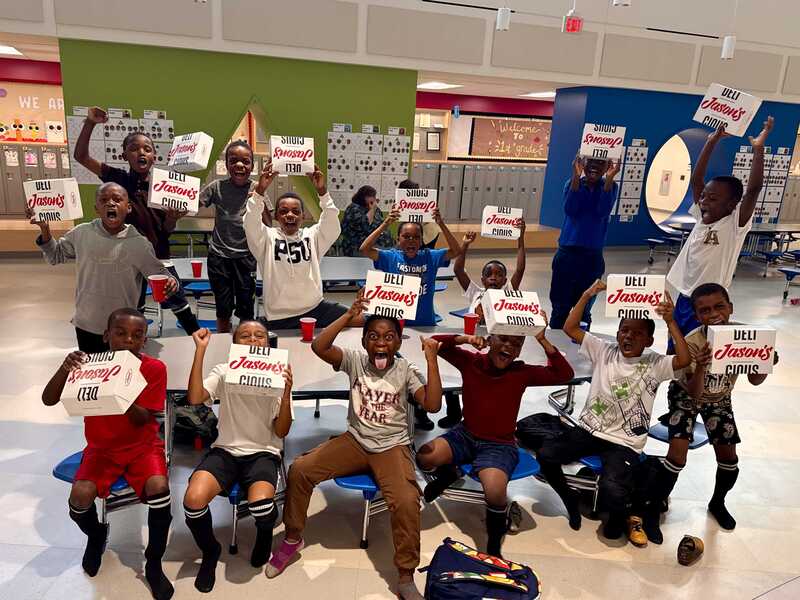 No single person solved everything. That was the beautiful part. Each time another problem appeared, someone in the village essentially said: I can take that one.
Fourteen Jerseys
On Sept. 9, Constance Lane hosted both Welsh and Barbour Elementary for games at 4:30 and 5:30 p.m. Before the games, the boys sat together eating turkey and cheese sandwiches, bananas and drinking pink lemonade. They laughed. They talked. They began getting ready. One by one, they laced up their cleats, many wearing pairs that Lane teachers had donated the previous year. Then I looked around. There were 14 Swahili-speaking boys wearing Constance Lane jerseys. Fourteen. Some of the same students who had initially believed they could not even stay for tryouts were now preparing to represent their school. And they knew how significant it was. I received hug after hug.
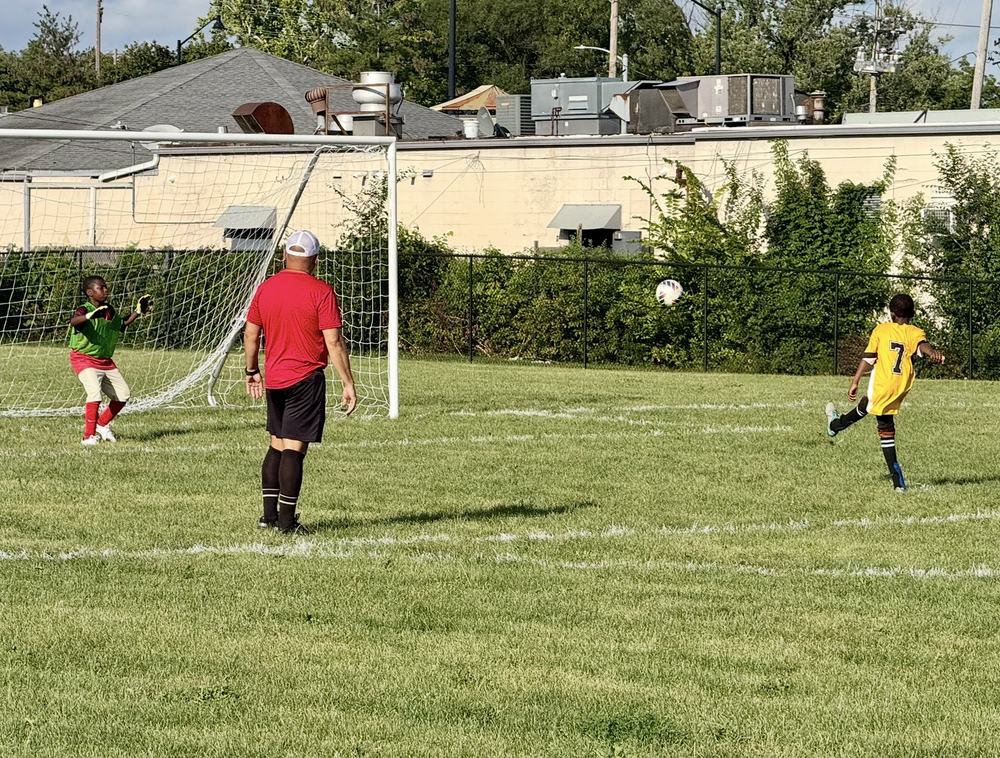
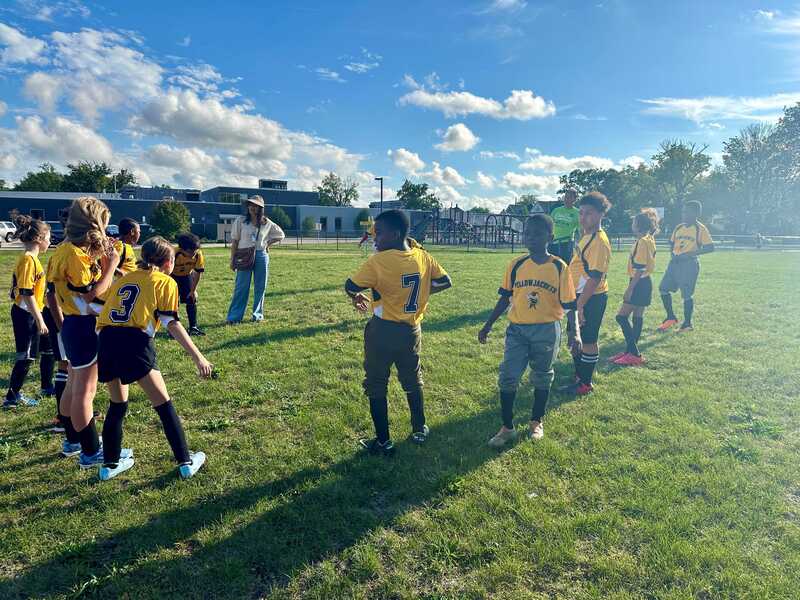 Then, once they were on the field, they started yelling back toward me. “Mr. Wilson! Thank you for this! Thank you!” That was the moment that hit me. Not a goal. Not the scoreboard. The jerseys. They were not standing outside somebody else’s opportunity anymore. They were in it. Which brings me back to that PE closet. I was still trying to find athletic shorts for some of our fifth graders when my radio came alive. “Hurder to Wilson, Njia just scored the first goal!” Njia. The boy I had pulled from the bus line. The boy who did not think he could stay for tryouts. The first student I had ever walked home. He had just scored the first goal for Constance Lane. I made it outside in time to capture his second goal on camera.
And then I saw what had been waiting behind all those barriers. These boys were dancing with the ball. They were comfortable attacking groups of defenders. They spun through traffic. They worked the ball through tight spaces, spotted teammates breaking into open field and slipped passes through until suddenly another Yellowjacket was one-on-one with the goalkeeper. They played with joy. They played with confidence. They played like they belonged there. This was not a group of children waiting for someone to teach them how to play soccer. They had been waiting for access to it.
Both Lane teams finished the night with 4-0 victories over Welsh and Barbour, with an emerging swarm of talented strikers leading the way. But the scoreboard was not the biggest victory of the night.
The Belonging Came Back With Them
Eventually, the field emptied. The equipment was put away. The boys climbed into the passenger vans. One by one, Lao Evangelical Church volunteers drove students home to their doors. For some of the boys, it was already dark when they arrived. Then the next morning came. I stood outside as the buses began pulling into Constance Lane. The boys did not all ride the same bus. One would step off. Then another would step off a different bus. And as soon as they saw one another, the smiles started. Big, unmistakable, ear-to-ear grins.
The jerseys were gone. The scoreboard was off. The goals were already part of yesterday. But the belonging came back to school with them. Maybe that is one of the greatest things an opportunity can give a child. A place where I belong. A place where I am skilled. A place where people know my name. A place where people expect me to show up. A place where I have something valuable to contribute. A place where I can say: I have a place here.I am valued here.
Years ago, Njia was the first student who showed me the way home. This year, an entire village helped make a way for him, and 13 other boys, onto the field. Soka Umoja started as a Swahili soccer club because there was a group of children we needed to reach. But on Sept. 9, I looked across that field and realized something had changed. They were not the Swahili soccer club anymore. They were the Constance Lane Yellowjackets. It started with a Bike Bus. It became a walking school bus. Then came home visits, home games, donated cleats, turkey sandwiches, coaches, supervisors, passenger vans, drivers, volunteers and 14 jerseys. It started with access. It became inclusion. And somewhere along the way, it became something even greater. It became belonging.